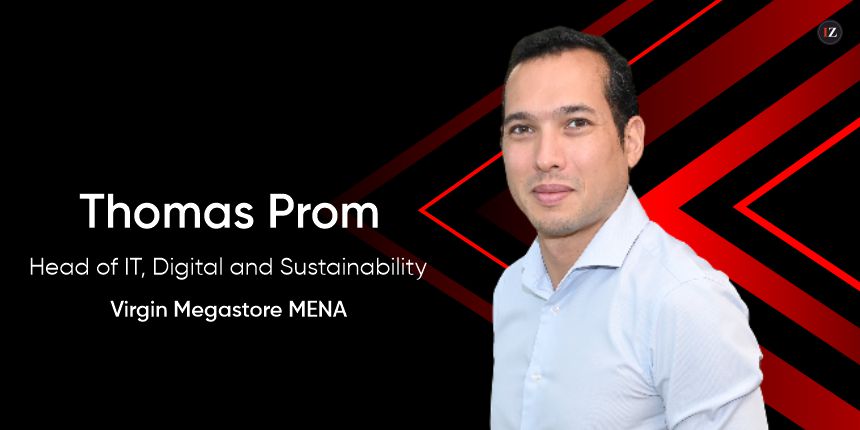
The most consequential leaders of 2026 are not those who merely adapt to change, they engineer it. Among them, Thomas Prom, Head of IT, Digital and Sustainability at Virgin Megastore MENA, stands out for turning moral clarity into measurable commercial results, quietly redefining what it means to run a responsible, future-ready retail organization.
A Recognition Built On Substance
When Prom received recognition for his sustainability leadership, the acknowledgment carried real weight. Most of his initiatives are long-term and transformational rather than flashy, and their recognition reinforced his core belief: sustainability leadership is about impact, not visibility. The acknowledgment strengthened his commitment to lead with impact-first decisions and to rally others in the industry toward the same standard.
Culture Before Compliance
Across Virgin Megastore’s diverse MENA markets, Prom’s sustainability strategy begins not with regulation but with culture. His team achieved what the trailblazer leader considers their most important result: moving from “what is global warming?” to “we want to change the world” within a single year. Local regulations are the starting point, not the ceiling.
While most MENA standards address only Scope 1 and 2 emissions; representing just two to five percent of a retailer’s footprint, Prom’s ambition reaches into Scope 3, where the real impact lies. His approach: pilot in one market, then deploy across others, always exceeding local standards and inspiring teams, customers, and peers to raise their own ambitions.
Opportunity, Not Sacrifice
Prom rejects the concept of sustainability as trade-off entirely. Drawing on his experience as a Climate Fresk activist, he argues that people change behaviour not when told what to avoid, but when offered better alternatives. For example, if you want someone to eat more vegetarian food, you could either explain why a beef burger is bad for the environment and health, or simply offer them a falafel sandwich. The first approach can make people defensive, while the second works naturally, without them even thinking about it. In business, rather than targeting emission reductions, the trailblazer leader frames goals as developing low-carbon business models.
Instead of selling less new, Prom tells his teams to sell more repairs, warranties, and services. One example: banning forever chemicals (PFAs) from cookware was reframed not as a sacrifice but as a chance to refresh product lines with premium, trusted brands, better for customers and stronger for the brand.
Sustainability Without Data is Green washing
Prom’s measurement principle is unambiguous: without data, sustainability is just a slogan. Just as investors demand audited accounts, sustainability claims require the same rigour. This conviction led to a region-wide carbon accounting programme aligned with the Greenhouse Gas Protocol, tracking every watt of electricity, every shipment, and every purchased good. With real data, the organization can set science-based targets, track progress, and identify where to act first.
From Retailer To Experience Provider
Prom reframes Virgin Megastore’s purpose entirely. The company’s role is not to sell a speaker or a phone, it is to deliver experiences and solutions. Through that lens, the circular economy becomes not only logical but inevitable. The work now underway includes renting speakers, offering refurbished phones, boosting repair services, facilitating trade-ins, and sourcing recycled materials. The goal is to reposition the business from a retailer of goods to a provider of experiences and to make that shift feel cooler and smarter than what it replaces. It also opens up new business opportunities: few people would buy a karaoke machine, but many would happily rent one for a night of fun.
Changing Retail Culture From The Inside
Cultural change in retail is hard. When Prom began in digital, he was told no one would buy shoes online. Today, the trailblazer leader hears that no one will buy a refurbished smartphone. The parallel is clear. From his experience in digital transformation, he knows that rules create compliance, but shared purpose creates passion and he chooses the second. Every employee has completed a three-hour Climate Fresk workshop, giving them the “why” behind sustainability. Prom also launched the Decarbonisation Alliance for Electronic Goods, inviting competitors to decarbonise together, and engaged the UAE’s Ministry of Climate Change to ensure public-private collaboration.
Making Sustainability Safe, Smart & Exciting
At the customer level, Prom’s team makes sustainable choices practical and desirable. Online, a sustainability blog breaks down complex topics accessibly. In-store, repairs and extended warranties are actively promoted, and a trade-in programme is backed by military-grade data wiping; removing every excuse not to give a device a second life. Sustainable product lines are highlighted so customers can choose better options without compromise. The guiding principle: don’t lead with sustainability. Focus on what people enjoy good taste, lower cost, fun, or convenience, and sustainability will follow naturally.
The Decade Ahead
For 2025 to 2030, Prom identifies circularity as the single biggest sustainability opportunity for retailers. Services are now intrinsically linked to sustainability, from repairs and refurbishments to rentals and extended warranties. By making circularity cool, practical, and profitable, the goal is to align business growth with the reality that infinite growth isn’t possible in a finite world, and to encourage others across the region to adapt early and stay ahead of the change.
Purpose-Driven Leadership
Prom’s leadership philosophy is purpose-driven and relentlessly customer-centric. KPIs signal that the organization is on the right path; purpose is the destination. A turning point came when he recognized that most of a person’s influence exists at work, not at home. The trailblazer leader decided to shift from being a conscious consumer to being a conscious professional, the biggest impact starts where influence is greatest.
Also, he believes that great speeches cannot compete with KPIs that have shaped careers for a decade. At Virgin Megastore, stores earn more when they facilitate a trade-in or sell an extended warranty than when they sell new. This aligns what is good for the planet with what is good for staff. You cannot rely on best effort alone, the task is to redefine what “best” means and commit to it.
Collaboration, The Next Generation & Reshaping Desire
Collaboration, in Prom’s view, is everything, built on genuine intent and clear purpose. To the next generation, he offers two messages: young people may lack purchasing power, but they hold cultural power. They define what is cool. And countless circular economy models remain to be invented; what is called “waste” today is often free raw material tomorrow.
Prom’s ultimate ambition is to reshape consumer desire. So people value what is meaningful and lasting over what is simply new, making sustainable choices something they genuinely want rather than feel obliged to follow.